ABOUT THE AUTHOR
Bernhard Christoph Lichtinger, here simply referred to as Lichtinger, was born on 21 July 1961 in Stuttgart, West Germany, the fifth of six sons. His father was a paediatrician, his mother a nurse. The household was strict, and life serious from an early age. Ten different schools meant constantly new faces, new teachers, new friends – and the early need to repeatedly prove himself.
Lichtinger worked in many different professions, including in a brewery, as a parcel delivery driver and in a photo laboratory. He later completed a skilled trade apprenticeship as a mechanical engineering technician. These years shaped his view of practical relationships, responsibility and the often invisible work behind functioning systems.
After completing his training, Lichtinger travelled the world and eventually ended up imprisoned in the former GDR. Because he refused forced labour and declined to cooperate with the state security service, he spent repeated periods of weeks in solitary confinement and darkness. On Friday, 13 November 1987 – two years before the fall of the Berlin Wall – he was expelled from the GDR to West Germany. This experience permanently changed his understanding of freedom, dignity and inner independence.
After his imprisonment, Lichtinger began to bring his own inventions into reality, among them the idea of a horizontal, sarcophagus-like vibration sauna for use in the living room, intended to support physical and nervous system regeneration. He later developed a specialised thermometer for green tea that emitted a short signal when the optimal brewing temperature was reached. He also envisioned a warning system for people wearing headphones in traffic, designed to alert them acoustically to approaching trams or electric vehicles before it was too late. Economic constraints, high protection costs and dominant providers, however, set clear limits.
From 1988 onwards, Lichtinger worked autodidactically as a freelance collaborator for a successful architect, until he founded his own property development company in 1995. The business grew over many years until the financial crisis of 2008 left its mark. In the years that followed, he lost almost everything: apartments, savings and financial security. He managed to save his old villa from the bank through a strategic manoeuvre. As he was obliged by the bank to complete two unfinished construction projects without pay, he additionally worked as a lifeguard and at times as a taxi driver to support his family.
Afterwards, Lichtinger was employed by the Stuttgart-based real estate agent Steffen W., who sought to benefit from Lichtinger’s many years of experience as a developer. When Lichtinger succeeded in brokering a large development site to an investor, Steffen W. had the office lock replaced and took over the project himself, thereby depriving Lichtinger of his commission. This experience once again sharpened Lichtinger’s understanding of power structures, loyalty and the fine line between trust and exploitation.
After renovating and selling his old mansion, Lichtinger settled matters with his former wife, Dorothee, and eventually followed his longtime great love, Suzanne, to New Zealand, – driven by the determination to begin once more entirely from scratch. There, he found stillness, vastness, and a new inner rhythm.
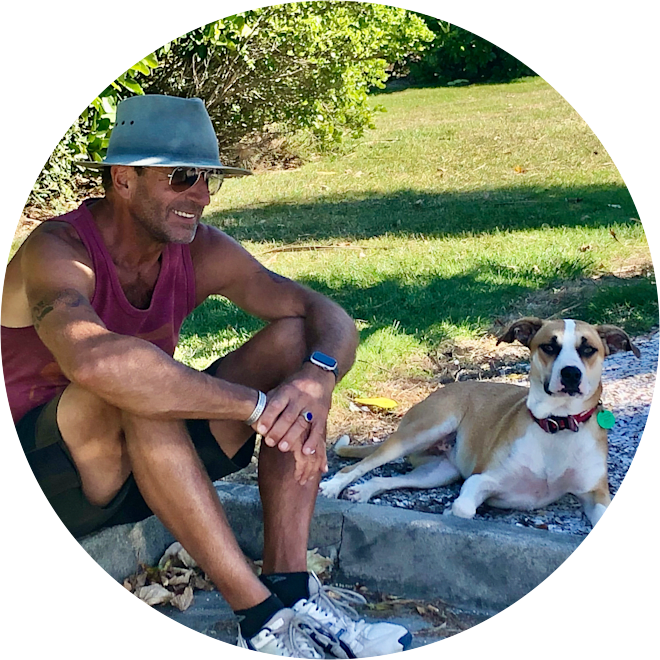
Today, Lichtinger lives with Rosie, his loyal dog, on New Zealand’s North Island. However, given the current global situation, he expects to return to the South Island, where space, calm, and perspective are easier to find.
Lichtinger does not write from theory or fabrication, but from lived experience, real encounters and the marks life leaves behind. His books combine observation, psychology and inner development – clear, calm and without pathos. He writes for people who are not seeking quick answers, but who wish to understand more deeply what moves us, wounds us and heals us.